Free shipping, no minimum · 90-day guarantee · Made in Orange, California
The Paddleboard Cup Holder.com ← back to the paddleboard page

The paddleboard guides

SUP Yoga: Where the Water Bottle Actually Goes When the Deck Has to Be Clear

Anchored, paddle in the water, leash off, deck cleared for poses. A zone-by-zone verdict on where a bottle actually survives an hour of SUP yoga.

12 min read · 9 sources

SUP yoga: where the water bottle actually goes when the deck has to be clear

There's a minute at the start of every SUP yoga session where the board briefly becomes a different object.

You paddle out to the spot. You drop the anchor and let the line come taut. You take the leash off your ankle, wrap it around the paddle shaft and lay the paddle in the water so it trails alongside — that's the standard move, and it exists for exactly one reason: deck space. Paddling Magazine spells it out in its beginner's guide: "Once anchored, take the leash off your ankle, wrap it tightly around the shaft of your paddle and then place the paddle in the water." Your waist-belt PFD comes off and goes under the deck net. The dry bag with your keys goes under there with it.

And then you're standing on a cleared board with a water bottle in your hand and absolutely nowhere to put it.

Everybody hits this. The advice you find is either "bring a water bottle" (yes, thank you) or the honest half-answer from that same guide, which is about sunglasses: put them "on a lanyard so you don't lose them overboard during downward dog." That sentence is the whole problem in miniature. Everyone knows things go over the side during a flow. Nobody tells you where the bottle is supposed to live for the fifty minutes in between.

Your body is the mat, so the deck is already spoken for

The reason there's no obvious spot isn't that the board is small. It's that in yoga, unlike paddling, the deck is the practice surface. Every square foot of it has a job at some point in the hour.

Look at where you're told to put yourself. Every SUP yoga guide in existence orients you off the carry handle. SUP Scout puts it as plainly as anyone: the carry handle "marks your board's balance point, and using it as a reference for where to place your hands and feet will keep you centered and steady in almost every pose." iRocker's pose guide has you park your navel over the handle in cobra, your sacrum over it in bridge, your feet on either side of it in warrior II. So the middle of the board — the widest, flattest, most stable real estate you own — is the one place a drink is categorically not going.

Now walk forward. In downward dog your feet sit just behind the handle and your hands walk out toward the nose, which means the forward third is under your palms, wet, with your whole upper-body weight on it. Buyers are specifically told to choose "a full deck pad, so you can use the entire surface of the board for your practice without slipping" — a yoga board is designed so that no part of the deck is off-limits to a hand or a foot. That's a feature until you need to set something down.

And the nose bungee, the one place on a paddleboard that exists to hold stuff, is triple-booked before class starts:

That's the actual audit. On an anchored yoga board, there is no square foot of deck that goes unused for a full class, and the single storage feature is carrying a life jacket, your keys, and possibly a paddle.

An anchored board moves in a way a paddled board doesn't

Here's the part that surprises people who came to yoga from paddling: the board gets harder to keep a drink on once you stop moving.

When you're paddling, you have a paddle in your hands. That's a brace, continuously available, and you use it without thinking every time the board gets pushed. You're also making way, and a board with forward speed holds its line. You can turn a few degrees and take a wake on the bow because you can see it coming and you have the means to react.

Anchored, you have given all of that away on purpose. The paddle is in the water. Your hands are on the deck or over your head. And the board is now a fixed object that the water moves past instead of a moving object that meets the water.

Anchoring off the nose helps with some of it — it's the standard advice because the front attachment "is generally the most stable and prevents excessive side-to-side motion, which is crucial for balance-based poses." Tied at the nose, the board weathervanes: it lines itself up with the wind and the current, so wind chop mostly arrives end-on, which you feel as a gentle pitch. That's fine. Nobody loses a bottle to wind chop.

You lose it to the wake, and a wake doesn't care which way your anchor line is pointing. A pontoon crossing the cove sends its wash on whatever bearing the driver chose. Meet that on the beam and the board rolls — the one axis a 33- or 34-inch platform has almost no answer for, on a board you can't turn, holding a pose you can't abandon. Even the anchoring guides admit the board will "spin a little" no matter where you clip in — the one fix they offer is a second anchor off the other end — which means that on a single hook your heading relative to that wake is a matter of luck.

And then there's the input nobody counts: you. A transition from a wide-legged stance to a low lunge moves a large fraction of the total mass on that board a foot or more sideways. That is a bigger disturbance than most chop. The bottle that survives an hour of ripples goes over on your own vinyasa.

Why the standard fixes fail here specifically

Most drink solutions for paddleboards are evaluated on a paddling board. Run them against a yoga board and the failures are different ones:

Under the nose bungee. Even when it's free, it's the wrong end of the board. Your hands are there in dog. A bottle wedged under a cord ends up on its side, which straw lids do not love, and retrieving it means kneeling and crawling forward on a board that is already moving — the single most exposed thing you do in a session.

A lanyard or tether. This is the sunglasses advice, extended. It works, in the narrow sense that the bottle stops sinking. It does not keep the bottle upright, and it puts a loop of cord loose on the surface you're about to press your palms and your face into. A cord underfoot in warrior III is a worse problem than a lost bottle.

Suction mounts. A yoga board is the one board in the category defined by having a full-length pad. Suction needs a smooth, non-porous surface to seal against, and a nose-to-tail EVA pad is neither. There's simply nothing left aboard for it to grip.

Adhesive, glue-down holders. Think about what this actually is: a hard plastic ring bonded permanently to the surface you put your sacrum on in bridge pose. It's the only solution on the list that can bruise you.

A hydration pack. The default hands-free answer for paddling, and completely inert here. You cannot lie on your belly in cobra wearing a bladder, and you can't do savasana on a hose.

The zone verdict

So where does it go. Honestly, board by board:

ZoneWhat it's doing during classVerdict
Nose / deck netPaddle, PFD, dry bag, anchor line; your hands in downward dogNo
Middle third, around the carry handleYour navel, your sacrum, your standing feet — this is the matNo
Aft of your feet, on the tail padYour feet reach back here in dog; your ankles cross it in savasanaBest available
The railsOne roll from open water, and reaching over a rail from a kneel is how people go inNo
Over the side, clipped and floatingFine for a can, useless for coffee, and it makes you reach over the rail to get itSituational
Someone else's boardThe real answer in a group class — see belowBest, if you have it

The tail is the answer on a solo board, and it's the answer for a specific reason: it's the only zone your body never loads at height and never uses as a handhold. Feet brush it. Nothing presses on it. If something does go over from back there, it goes over behind you rather than through your hands.

Two caveats, because the tail isn't free. Savasana runs you the full length of the board, so at the end of class the bottle moves once — one move per session, not one per pose. And on boards where the pad stops short of the tail, everything aft of it is smooth wet PVC or glass sloping toward the water, which is worse than the pad in every way. Know where your pad ends before you commit.

In a group class, take the better option. Classes get tied off in a flower — boards clipped nose-in around a shared center — or daisy-chained rail to rail off a passed line. If there's an instructor's board or a center board sitting still in the middle of that, your bottle belongs on it, not on yours. It's the steadiest surface anywhere in the cove, and you're already clipped to it.

Change the goal: the bottle doesn't need to be sippable

This is the reframe that fixes most of it.

You are not going to drink mid-flow. Nobody breaks a sequence to hydrate, and the moves required to do it — kneel, crawl, unscrew, re-stow, stand — are riskier than the thirst. The mid-pose sip is a fantasy sold by product photos.

What the bottle actually has to do is still be there, still upright, and still full when class ends. That's the job. Judge every option against that job and the picture clarifies fast, because the drink windows in a SUP yoga session are fixed and there are three of them:

  1. At the put-in, while you're screwing the fin in and pumping. Drink here. Full stop.
  2. At the anchor, in the two or three minutes between dropping the hook and the first breath, while the class sorts itself out and the instructor waits for stragglers. This is the real hydration break and almost nobody uses it.
  3. After savasana, sitting on the tail, before anyone paddles in.

The sun makes those three windows matter more than they would on land. A session runs long — beginners are advised to keep the first few to 20 or 30 minutes and build from there — and it runs in the open, with UV coming off the water as well as down from the sky; the CDC notes UV rays "reflect off of surfaces like water, cement, sand, and snow," and there is no shade anywhere in a cove. An insulated bottle is the right call, which is also why it's the container hardest to keep on deck: tall, heavy up top when full, and steel, so overboard means gone rather than floating.

The setup, in order

Ten seconds of sequencing at the anchor buoy saves the whole hour:

  1. Anchor to the leash plug or a D-ring, never the bungee.
  2. Decide the paddle: in the water on the leash, or flat under the nose bungee. That single choice determines whether the net is available for anything else.
  3. PFD on the waist or under the net. Keys in the dry bag, under the net.
  4. Drink now. This is window two.
  5. Bottle to the tail, inboard of both rails, capped, sitting on something that resists tipping.
  6. Everything else stays in the truck.

Bring a bottle with a lid and a plain, flat, handle-less bottom. A handled camp mug is a bad container for a moving deck under any circumstances — there's nowhere to grip it low, and the handle is a lever pointing sideways.

Where our thing fits, and where it doesn't

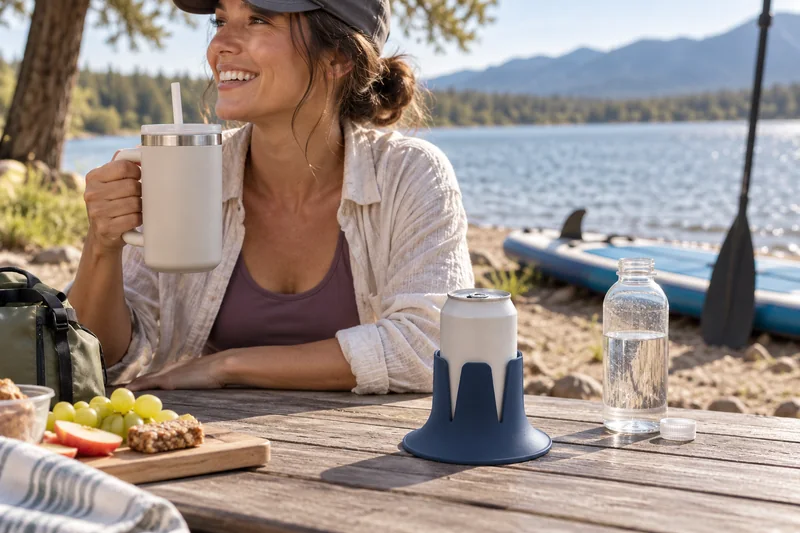
We make one: the Steadi base. It's a single piece of TPU — never silicone — molded in Orange, California, patent pending, about 5.2 inches across and 2.8 inches tall. Flexible fins grip the bottom inch of the container, and the base is fixed: it doesn't expand, contract or deform. What that width buys you is a wider base of support than the bottle has on its own, so the container's centre of mass has to travel much further sideways before it passes outside that base — meaning it takes a considerably bigger tilt to tip. The material's tack does the rest, resisting sliding — and unlike a suction mount, it never needed a smooth, non-porous surface to seal against in the first place.

The reason it suits this scene specifically is that it doesn't attach to anything. Every other option on the market bolts to hardware — bungee, D-ring, adhesive, suction — and hardware is exactly the wrong answer on a deck whose function changes five times in an hour. You want the drink to move when the practice moves: set it on the tail for the flow, pick it up one-handed before savasana, carry it in the same hand to the dock. Nothing to unclip, nothing left permanently in the way of your hip.

Now the parts we'd rather you heard from us:

Fit is about the base of the container, not the top — bottles taper and tumblers flare. So don't go by the name on the bottle: measure your container's base and run it against the current fit test and container list on the main page. It takes about four seconds at the truck.

Free shipping, and 90 days from delivery to decide — used is fine, returns are free. If it turns out your deck, your board and your flow don't want it, send it back.

Everything else on that board has a strap, a plug, or a job. This is just the one thing that finally has a place to sit.

Wondering about your specific cup? The fit database has sourced base measurements for 30+ containers — Stanley, Red Bull, Yeti, and the honest no's.

Sources

  1. Paddling Magazine (Anna Levesque) — Once anchored, the standard move is to take the leash off your ankle, wrap it around the paddle shaft and put the paddle in the water; buyers should choose a full deck pad so the entire surface is usa
  2. SUP Yoga Pilates — Anchoring from the nose is 'generally the most stable and prevents excessive side-to-side motion, which is crucial for balance-based poses'; the center handle is used for symmetrical group setups; anc
  3. Northwest Paddleboarding — Clip the anchor line to the leash plug or a D-ring — 'Avoid bungees, they aren't made to handle the tension'; 15-20 feet of line is typical; the board will spin a little regardless of attachment point
  4. SEAVASANA — A SUP yoga studio's class-prep page: bring a water bottle and a fanny pack or dry bag for keys; boards have deck nets for storage; the low-profile waist-belt PFD 'can remain comfortably on your person
  5. SUP Scout — The carry handle 'marks your board's balance point, and using it as a reference for where to place your hands and feet will keep you centered and steady in almost every pose'; lay the paddle flat acro
  6. iROCKER — Pose-by-pose placement is referenced to the center handle: navel over the handle in cobra, sacrum over it in bridge, feet either side of it in Warrior II; 'Your center of balance should stay directly
  7. OutdoorMaster — The competing paddle convention: 'you can put your paddle down on the board perpendicular, and secure it with the bungee strap' — i.e. the nose bungee is occupied by the paddle in many setups.
  8. U.S. Centers for Disease Control and Prevention — 'UV rays can reach you on cloudy and cool days, and they reflect off of surfaces like water, cement, sand, and snow'; UV is strongest 10 a.m. to 4 p.m. daylight saving time.
  9. Bluefin SUP — Centering guidance for SUP yoga: 'look for your SUP's handle. This will be your centre point!'
Get yours — shipping's on us

The order completes on steadilabs.com — Steadi Labs' storefront.